
The Triangle of Flourishing: Three Dimensions for a Meaningful Life
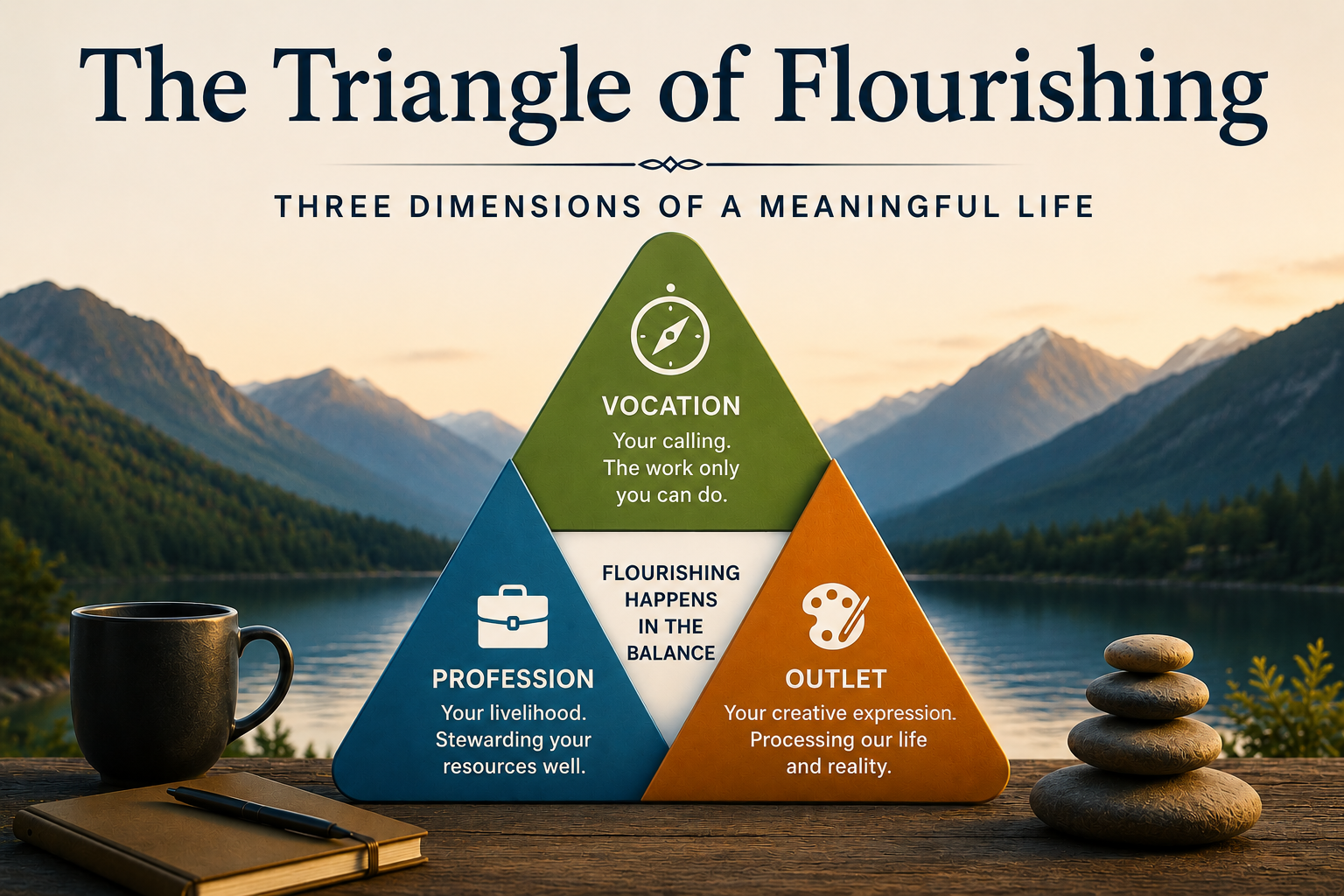
Triangle of Flourishing Framework
“Tell me, what is it you plan to do with your one wild and precious life.” –Mary Oliver
What do I do now?
When I first walked into that Middle School English classroom, I knew I was finally doing it—I had finally transitioned into the field that I had dreamed of and spent a few years fantasizing about. The job was grueling, but it was good work. Every day I woke up energized to tackle the glorious challenge of teaching Language Arts to the crazy and mischievous pre-teens and the more important work of shaping them into responsible human beings.
And then, at the end of the month, I got paid.
To be fair, I knew going into the role it was going to be a lower income (starting out) than the job I was coming from. Before taking the role, I had done all my calculations and financial predictions. It was going to be tight for a few, but we were going to be fine.
Or so I thought.
Due to a perfect storm of unanticipated issues, the details of which would take too long to recount here, the budget at the end of the month was red.
Red? That wasn’t right. Maybe we were going crazy with eating out. Perhaps a little too much DoorDash. We’ll just cover it from the savings and lock in for next month. Yeah?
But next month was the same.
And so was the next.
Now I was becoming worried. As we did some meticulous financial combing, the horrifying truth began to emerge. This wasn’t an overspending problem. This was a math problem. And it was a problem that required immediate surgery.
I knew that leaving was the right answer for the family. Despite this, it still troubled me on a soul level to leave the kids I had grown so attached to and to leave a job in which I was experiencing so much deep fulfillment. Nevertheless, several months later, I exited the field of public-school education.
Now what?
What in the world was I going to do now? Where would I go? And, by taking the job in the first place, did I “get it wrong?”
I tell this story because I know many who have the same struggles. High School/College students looking to jump into life… the 35-year-old looking to make a change… that person in a role that makes them feel dead inside… all of them are asking the same thing: now what? What in the world am I going to do? Where do I go? How do I avoid getting this thing wrong?
What follows below is an intellectual framework that I began to develop during the days of my transition (I’ve since jumped into a different field), and it is one that I only recently began to put shape to. It is a framework designed to give us a method, language, and categories through which to think our way through these deeply personal questions surrounding meaningful work. I will call it “The Triangle of Flourishing,” for it details the three dimensions we need to pay attention to if we are to find that soul-level satisfaction that we are looking for as we engage life and career. The three dimensions are vocation, profession, and outlet. Vocation provides purpose, profession provides provision and resources, and outlet provides a place to process our reality. It is called the “Triangle of Flourishing” because our lives blossom when all three dimensions are not just cultivated but allowed to work in harmony.
The Triangle of Flourishing
Note, this framework isn’t some “secret knowledge” or something that “the world has never seen before!” Nor is it designed to make decisions for you or to be a one-size-fits-all model. Rather, it is an organizational tool born from the intersection of my personal experience and the broader body of vocational literature. Its purpose is to help us make sense of the conflicting desires that often emerge when we navigate questions of purpose, provision, and creative expression. It may help to think of each dimension as answering a specific question:
Vocation answers: What am I called to contribute?
Profession answers: How do I create stability and resources?
Outlet answers: Where does my soul find expression?
The challenge that many people face is that they may unintentionally ask one dimension of their life to do the work of all three. For example, when we expect our professions to provide the total fulfillment of our purpose and self-expression, we often find them lacking. When we expect our outlets to carry the full weight of our financial needs, we may find that they cannot do so. And when we pursue our vocations to the neglect of the practical realities of provision, life becomes unsustainable. Flourishing only occurs when our vocations, professions, and outlets exist in healthy collaboration in our lives. Let’s talk more about them below.
Vocation
Vocation is the root of it all. It is a common thread. The through-line connecting to all of your activities. In my operationalization of it, we could also label this one “calling.” As we grow from adolescence into adulthood, we uncover recurring desires, burdens, and impulses to contribute that seem woven into the very fabric of who we are. These are often clues to our vocation. To put it another way, vocation is usually found in identifying the contributions we feel compelled to make in the world that don’t seem to leave us alone. And while vocations grow, clarify, and somewhat evolve as we experience life, our vocations don’t really change. Why? Because they’re not jobs or simple passions. They are central or macro-level themes that animate us. These are themes like: shaping the minds of others, leading people through darkness, bringing order to chaos, sparking joy into the environment, healing the body and mind, solving complex problems with one's hands, etc.
When I left the field of teaching, I feared that I might be “running away from my calling” and that there would be “no other way I could find fulfillment.” While I no longer taught classes for my 40-hour work week job, I picked up something else—I began to organize curriculum and craft Bible studies for the men’s small group in my church. This act breathed new life into me and solidified the truth: professions can change, but vocations don’t have to. My vocation wasn’t “being a schoolteacher.” My vocation was more like “shaping the minds of others through the generation and presentation of instruction.” Could that find a place in public education? Absolutely. But it doesn’t have to. Realizing this truth opens our minds to consider avenues of fulfillment we would have never thought of as viable. The person called to heal others may not have the money to go to medical school, but may find the same fulfillment running their church’s 12 Step group. Vocational fulfillment doesn’ always mean changing jobs. It may simply mean approaching your work in such a way or find a role that allows you to express those elements of your calling.
If you’re saying to yourself, “how in the world do I discover mine?” Pay attention to your internal wiring, life experiences, and themes. Additionally, it could help to ask yourself the following:
· What problems consistently bother me?
· What kinds of people do I want to help?
· When do I feel like I’m “in my bag” or most alive/useful?
· What types of work/activity do I fantasize, daydream, or lie awake thinking about at night?
Profession
Profession is the primary mechanism through which we create stability for ourselves and those entrusted to our care. It is where our purpose encounters the practical reality of having to pay a mortgage, fill up the car, and pay for insurance. Dreams and passion are nice—but you can’t buy groceries with them. Surviving in this world requires resources, and sometimes we must settle for something functional over highly desirable. If vocation is the root, profession is the trunk (the strong and sturdy thing that is visible from the surface and holds everything together). If you’re the person who has always dreamed of being a painter, that dream may need to be adjusted in light of practical financial realities. Professions, therefore, function as the vehicle that enables us to have the space for our vocations and creative outlets.
Sometimes we become confused about what we should do because we’ve bought into the modern myth that there must be a one-to-one correlation between our vocation and our profession in order to achieve meaningful work. If we saw those as two dimensions instead of one, however, we’d be far more at peace with developing some type of flexible arrangement between the two—achieving material sustainability and psychological meaning. Tips for finding a good profession? Look at some of the following factors:
· What am I good at/how am I naturally wired?
· What are my experiences so far?
· What types of things interest me and are they avenues for material success?
· What is realistic for me to pursue in this season of my life?
Outlet
Your outlet is where the soul (mind, will, emotions—your “you-ness”) finds expression, often through creative means. With that said, this section is not just about expressing oneself—it is also a place where you process life and reality. The previous sentence is key since most people equate “outlets” with “hobbies.” While all outlets are hobbies, not all hobbies are outlets. The key difference is the role it plays in your life. Hobbies often function as methods for us to relax and unwind. They are simplistic, rarely result in an output, and can often be mind-numbing (like crashing on the couch and watching TV). Outlets are deeper than that. The same person who watches a movie as a hobby in order to get his mind off of work can watch movies as a creative outlet (one that generates thoughtful post-movie reflection on the themes presented in the storytelling because they love the world of theater). Hobbies are merely about consumption and entertainment. Outlets often lead to something being produced, life being processed, or an experience being gained. Let me give you some examples in couplet form to give you a better appreciation for outlets.
· Hobby: listening to music to take your mind off work
· Outlet: listening to a song about heartbreak in order to help you process your own emotions
· Hobby: painting because it’s fun
· Outlet: painting scenes that help you express and make sense of a significant loss
· Hobby: writing short stories because you enjoy creating worlds
· Outlet: writing short stories in a way that allows you to explore the concepts of good, evil, sacrifice, and redemption.
· Hobby: exercising to keep your body tight
· Outlet: running distance as a way of reflecting on perseverance and working through life’s challenges
Notice that with each example, it doesn’t matter what you do. What matters is the role it plays in your life. And with outlets, they function to help you process, express, or understand reality. This is why we all need outlets.
The big problem with outlets, similar to vocations, is when we try to prematurely lean on outlets as if they were ready to become our professions. Think of the example of the person who loves making music in their spare time. Even if guiding others on an emotional journey through song is not just an outlet but one of his core vocations, it may be irresponsible to drop everything in order to move his entire family out to LA in hopes of securing that one meeting that will change his life.
The example may sound silly, but when it comes to the things that we are passionate about, we often don’t see clearly. Many a married couple has argued about this very topic. Understanding outlets as just one part of a three-part framework, however, allows us the ability to categorize our creative ventures into appropriate spaces and make those financial allocation conversations easier. This is not to say that our outlets can never become our professions, or that starting something new doesn’t come with its own risk, but having something in the outlet category lets us know “I should make room for this in my life, but maybe in reasonable doses as my budget sees fit.”
Bored, Anxious, and Fragile
While the triangle may not always be 100% equilateral, and while our devotion to each dimension will alter seasonally as our life happens, we will be at our most fulfilled, peace-filled, and intellectually stimulated when all three exist in some sort of proper harmony. Neglecting one in favor of the others leads to the following specific negative experiences:
· Neglecting vocation leads to boredom: having a life where we focus on our professions and make room occasionally to be creative can work… for a while. After a certain amount of time in the same role, if we have not found a way to integrate it with our life vocation (or found enough vocational stimulus outside of our profession), our passion slowly dies. We grow fidgety. Our emotional engagement retreats. Our complaints rise. When our energy has completely left because we haven’t found room to practice our deep core themes, we become intellectually bored. Unfulfilled. And then we start looking for other work or at least something to excite us. We need to be careful with that last point, because sometimes excitement does find us—and it’s not the healthy kind.
· Neglecting the profession leads to anxiety: how much material resources we need to feel at ease depends largely upon where you live, how you want to live, and what type of person you are. Look at my teacher example. Vocationally, I was off the charts in terms of satisfaction. Creatively, I was somewhat fulfilled (in terms of the work but not in my personal ventures). In terms of being at peace? The hits that I was seeing to our budget completely overshadowed my sense of satisfaction from the other two dimensions.
· Neglecting our outlets leads to fragility: I found fragility to be accurate here not because we are weak, but because of what outlets do for us. Since we process our experience through them, if we cut this part off, then we become those people who aggressively build our towers but cannot pay attention when rot starts to eat away at the foundation from within. The longer one works (even if meaningful work) without any room to process what is happening to them, the more brittle one becomes. This is running at a suicide pace. And we can only sustain so long before we crack, break, or enter a crisis.
Final Thoughts
Nothing in the above article tells you what to do, which college to go to, which job to apply for, or if you should step left or right. While this approach may frustrate some, the point is to give you a model through which to think. I also acknowledge that equal devotion to all three dimensions of the triangle may not be possible at all times. We may simply exist in a season where we have to pour all of our gas into a specific, non-fulfilling job in order to achieve financial freedom. Or perhaps we are moving through one of those rapids in life where we simply cannot process the fast-moving events that are thrown our way through our creative outlets.
This model serves us well by enabling us to identify what we are missing, how it affects us, and what we need to restore. The difficult trade-offs we must make daily in order to make life work are very real. The fact that many of us will never have our “perfect job” is also real. While this may initially cause us to despair, this model gives us a reason to hope. It dares to offer us a pathway by which we may achieve a sense of deep and personal satisfaction as related to our work. This satisfaction—this flourishing—is achieved when vocation, profession, and outlets are each given room to breathe.