
The Patriot’s Paradox
What an Unfinished Cathedral Can Tell Us About the American Story
Written by R.J. Wilson | July 5th, 2026
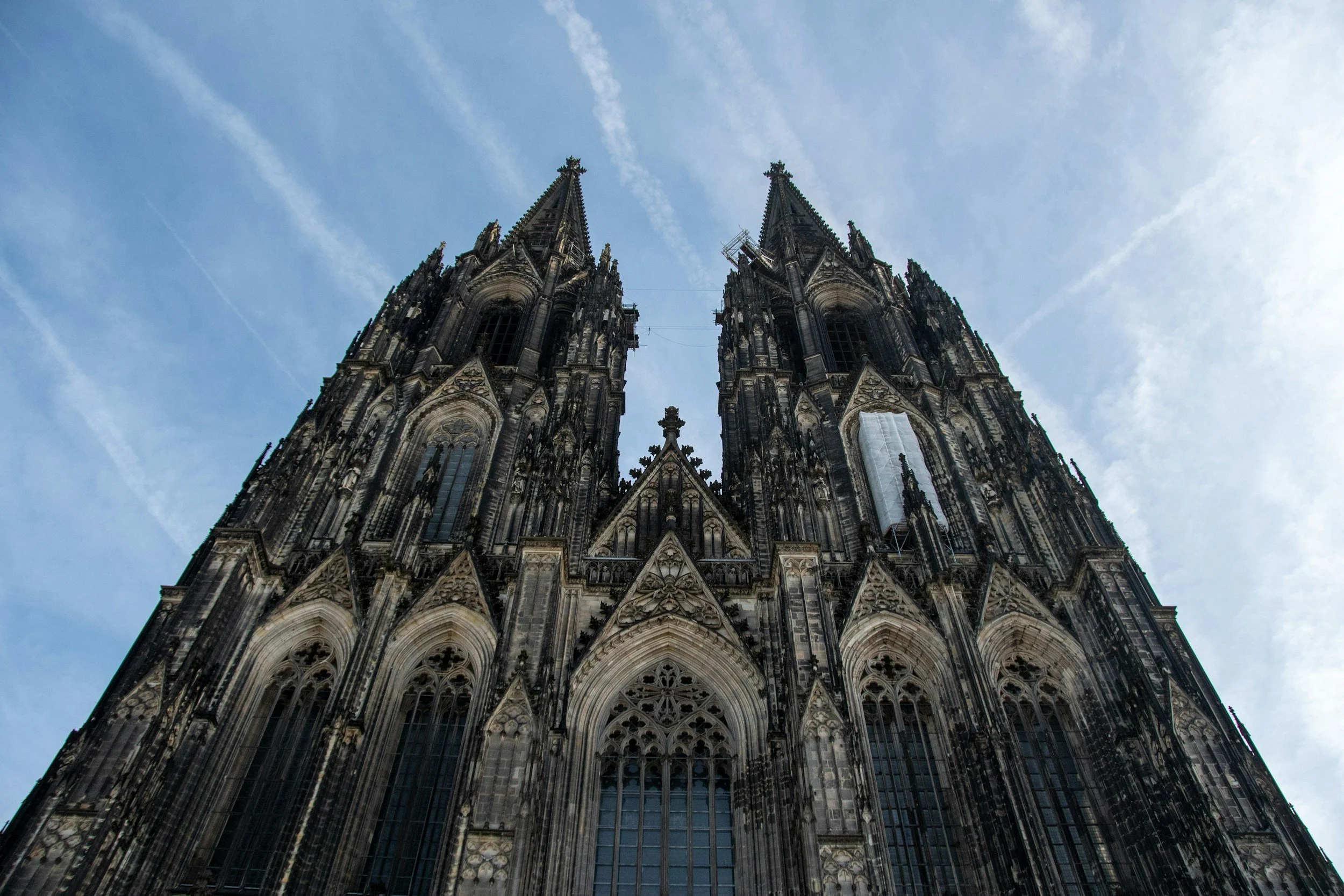
Image of the Cologne Cathedral
With the arrival of the year 1240 arrived, Catholic leaders in Cologne, Germany realized they had a big problem. Massive waves of visitors flocked to the city in order to view the recently acquired bones of the three Magi (the three characters who brought baby Jesus gifts while he remained in a manger according to Christian and Catholic tradition) and their current cathedral was not up for the task. They needed to refurbish. No. They needed an entirely new cathedral. Further confirmation, some would argue it as divine, would come in 1248 when a maintenance fire got out of control and burned through sections of the existing cathedral.
Now was the time.
In 1248, Archbishop Konrad von Hochstaden, along with the construction crew, began the first steps of laying what would become the largest and perhaps most famous gothic cathedral in all of northern Europe. And, most remarkably, Archbishop Konrad knew he would not be alive to see it completed. Neither would the construction crew. Nor their kids. Nor their kids’ kids. You see, this great architectural wonder was not completed until 1880—632 years after it had been started![1] That means that the people writing the blueprints only saw the final version in their dreams. The stone mason accurately cutting a cornerstone would never see the finished product. Those who set out to begin the task would never walk through the completed sacred halls.
As I think about this marvel of human collaboration and ingenuity, I wonder what it must have been like for the original team. They were building something that would expand generations. In addition to that, workers had to navigate serious challenges like lack of funding, changing political priorities, issues within the building itself, wars, and the shifting political/religious landscape of the world threatened to stop the project cold. And all this doesn’t even mention the constant war against decay, overgrown weeds, and the demotivation of an idle crane sitting atop the unfinished building for 300 years. For as long as the project lasted, these two things were desperately true: what the cathedral was being built into was something beautiful, and at the same time, the cathedral was and is an unfinished project in desperate need of building and repair.
As I celebrate my country’s 250th birthday, it has me thinking a lot about what it took to build this nation. In many ways, I think the great American experiment is not all too different than what was done in Cologne. In a similar way, the founders set out with a vision and a plan to build something unique, bold, and long-lasting. As we sit, 250 years removed from those efforts, the American patriot holds two truths in dynamic tension: the American vision is a beautiful construction project and, at the same time, the American project is constantly in need of maintenance and repair.
A Beautiful Vision
The Declaration of Independence states the following famous words:
“We hold these truths to be self-evident, that all men are created equal, that they are endowed by their Creator with certain unalienable Rights, that among these are Life, Liberty, and the pursuit of Happiness. That to secure these rights, Governments are instituted among men, deriving their powers from the consent of the governed…”[2]
The Declaration of Independence issued a bold statement as a daring blueprint for the kind of nation the founders hoped to build. Though there was disagreement between the founders, the nation’s founding documents (the Declaration, and later, the Constitution) articulated concepts like equality of all people, a government by consent of the governed, and the rights to life, liberty, and the pursuit of happiness. These documents couched these notions in divine language to communicate the message that one’s worth and value was supposed to transcend values assigned to them by other mortals (like the government or ruling elite). The beauty in this language becomes significant when we take a moment to understand the context it was speaking to.
Across the sea sat a king who ruled by divine right and blood lineage, and required absolute fealty to the crown. His legitimacy supposedly flowed from heaven. It was only right, therefore, for political power and privilege to remain concentrated in the hands of the king and the upper-class. To disobey the monarch was to disobey the will of God himself. And though Parliament had already placed some limits upon royal power, the mindset of imperial rule still remained. The founding documents of our nation, in contrast, proposed radical concepts like equality of all under the law, rule born from the consent of the governed, human rights granted by God alone, and (most scandalous of them all) a right to criticize and rebel against the injustices of a powerful government gone corrupt. Legitimacy, in this system, would flow from the people.
These concepts became the foundational stones that would build this nation and distinguish it from the empire from which it emerged. For, in sharp contrast to other nations, our nation was not meant to rest merely upon the foundation of blood and soil, ancestral lands of descent, or the lineage of inherited privilege. At least in the founders’ vision as laid out in our principal texts, room was given for building upon a shared commitment to enduring ideals—ideals enshrined in law and embraced by the people who would become citizens. This blueprint, more than shared ancestry, was what would bind a remarkably diverse group of people together into the grand fabric of a national story.
A Work in Progress
With the above said, I imagine that some are already spotting areas of inconsistency between the written “ideal” in 1776, and the current “real” in 2026. You may point to slavery and subsequent Jim Crow, the treatment of women, and even modern-day examples that demonstrate existing legacies of racism, sexism, people with money accessing certain freedoms that elude the less fortunate, and other instances that seem at odds with the ideals outlined above. These points of incongruence are very real, and they are exactly my point. The American patriot is caught in a paradox. He must embrace both truths at once: the founding core of the country did contain beautiful ideals, and the project is constantly in need of maintenance and repair.
The Cologne Cathedral tells the same story. It too had a long history of starts and stops. Stones had to be replaced. Work had to be redone. Part of the way through, some of the sections collapsed and had to be fixed. Even today, though it is “finished,” it still requires dedicated workers to tend to it. Why?
Because all great structures constantly face the decay of time and weather.
Nations are the same way. Time exposes weak stones. Corruption from the unjust settles into the cracks and makes it chip. Selfishness and greed erode the central pillars. Complacency relaxes the guard into an “it could never happen here” attitude. Careless actions, malicious actors, and poor vigilance stand at the gate, constantly threatening to tear down what has been built. Citizens and leaders have to be especially on guard because great projects attract both devoted builders and selfish opportunists. Some are drawn by a vision of what could be. Others are drawn because they realize they can sell their ordinary bricks as “superior” and for an exorbitant fee. To be clear, I’m not talking here about those who arrive with a sincere hope and a dream. I’m referring to those who seek to bend American momentum away from project completion and toward their own interests at the expense of the common good. In addition to external challenges, large project crews have to navigate internal challenges—generations of people cycling through feelings of discouragement, frustration, despondence, and the hopeless feeling that this grand plan would never become complete. What is one to do when they face the overwhelming difficulty of persevering through something when it would make much more sense to give up?
We build anyway.
Is it because the problems, cracks, bad actors, and issues don’t exist?
No.
It’s because we choose to believe that the original vision contains a promise strong enough to rise above the mess and one compelling enough to build. And though, like the cathedral, the original founders probably couldn’t picture the exact final form it would take across time, we continue to build something that is faithful to the inherited vision anyway, and do it in a way that fits our context.
The Patriot as Builder
The word “patriot” or “patriotism” has become one of those buzz words that people often claim with great confidence. I think many understand it primarily as a feeling—a deep affection for the country, the gut reaction that our team must be the best, the goosebumps on one’s arm when the fighter jets fly overhead, the tears that come when we see one of those surprise military homecomings, or the feeling of pride one has when the nation’s flag is raised and waving.
I’m actually less willing to define patriotism that way. I’m also less inclined to attribute weight to it as true just because one claims the label for oneself. Is it possible to define the American patriot as something going beyond what one feels? Instead of describing what one feels during the national anthem, what if patriotism was a verb? What if it was an action word used to describe someone who has chosen to take part in carrying forward the ideals of our nation as it applies to our current time? Patriotism, therefore, would not come by word of mouth but by placing one’s hands to a certain set of actions geared towards contributing to the American project. Now, this contribution looks different for everyone. Some will lay foundational stones, some will install windows, some will mix mortar, others will repair ceilings, still some will craft breathtaking paintings, while others direct the placements of items, order logistics, or strategically plan next steps. From the politician in Washington, to the individual person in Wyoming, building and maintaining this cathedral is a cross-generational effort. It requires truth-telling instead of propaganda, honest reflection instead of selective blindness, serving our neighbors instead of viewing them as the enemy, listening more and arguing less, respect for the institutions along with the courage to hold them accountable, the refusal of corruption as we pursue justice, and the willingness to place the common good above one’s individual tribe. The patriot practices these virtues within the halls of power (law, policy, courts, and resources) as well as in their individual lives (cities, towns, neighborhoods, families, and friends).
Lay Your Stone
Every generation inherits this unfinished cathedral. In viewing what we have been given, one category of workers is tempted toward despair, seeing only half-finished towers, the construction cranes, steps that have yet to be built, or those who would corrupt the project. Another category of workers is tempted toward indifference, pretending that the cracks do not exist because they lie outside of their own specific workstations.
The true patriot views our story with both an honest reflection of the past and a sincere desire for the future. We come to grips with a story of both breathtaking beauty and profound brokenness. He acknowledges that we have been given an inheritance—a task that the founders passed on to future generations to steward faithfully.
And with that inheritance comes a responsibility.
The responsibility to build faithfully even knowing we won’t see the finished product.
So, to those who dare, choose to build. Not because of blood. Not because of soil. Not because we like or dislike the seat of the powerful. But because we believe that the ideal is worth building. And that we, in order to form a more perfect union, have both the privilege and responsibility of laying another stone for our sake and the sake of those coming after us.
[1]https://www.britannica.com/topic/Cologne-Cathedral
[2]https://www.archives.gov/founding-docs/declaration-transcript