
Kingdom Last: The Danger of Making Jesus Into One of Us
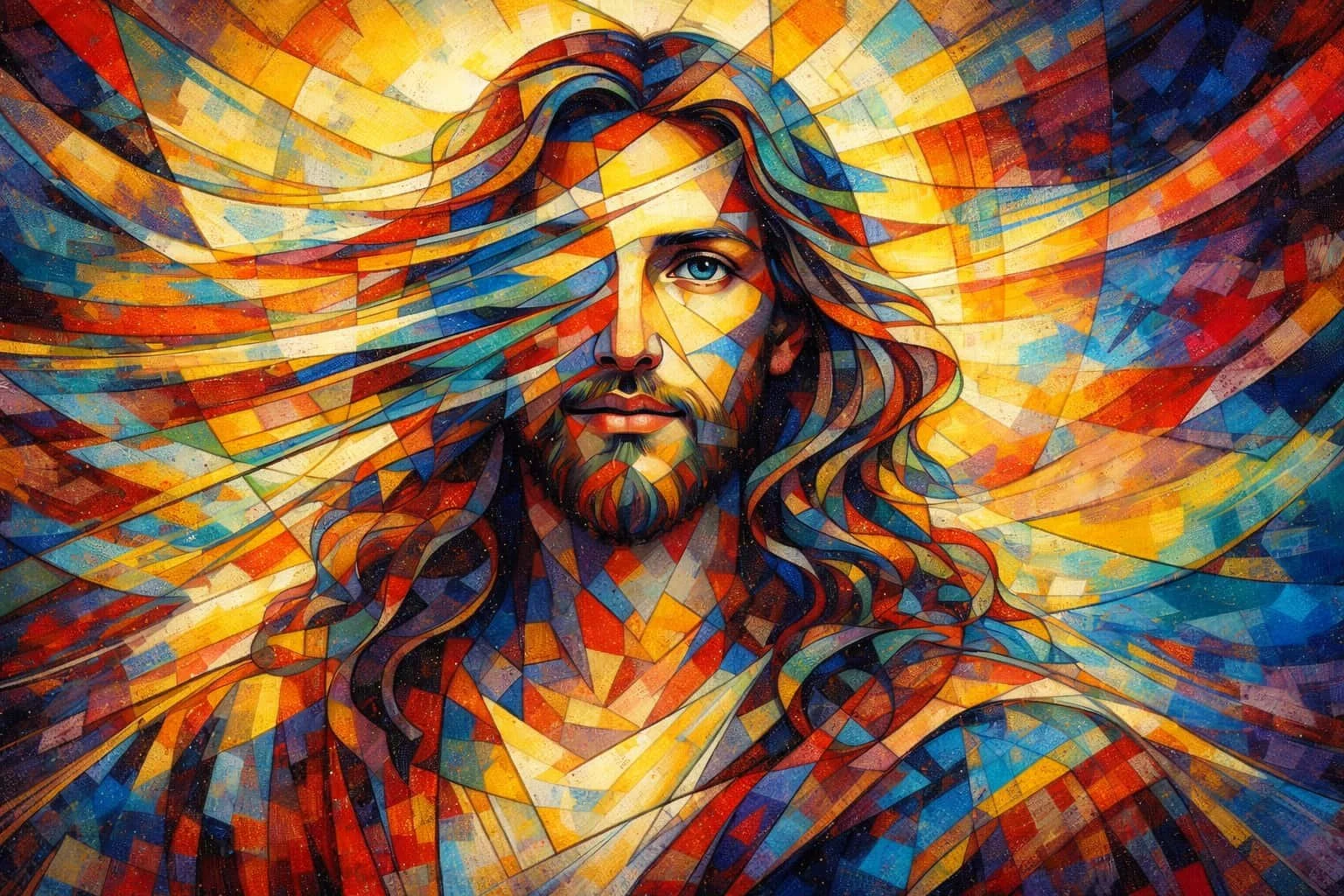
Abstract Jesus like figure in vibrant cubism style
On September 10th, 2025, the nation witnessed a tragedy that spread as far as the internet is wide: the real-time assassination of a human being beloved by many–conservative influencer Charlie Kirk.
Given his status in the minds and hearts of many, his funeral was a pretty big deal. Many famous and powerful voices were heard that night expressing condolences. But, for some, those condolences quickly turned into a rallying cry. An invitation for action. A call for war.
Take, for instance, remarks from the well-known and controversial Stephen Miller (White House Deputy Chief of Staff):
“The light will defeat the dark. We will prevail over the forces of wickedness and evil. They cannot imagine what they have awakened… You cannot terrify us. You cannot threaten us. Because we are on the side of goodness. We are on the side of God.”[1]
Consider also, the voice of conservative activist Jack Posobiec:
“Are you ready to fight back? Are you ready to put on the full armor of God and face the evil in high places and the spiritual war before us?”[2]
As a Christian, I found these comments and others like them, strange. I’ve been thinking about them over the last several months. For starters, I do believe that light will defeat darkness. I do believe that negative spiritual forces attempting to bring us down should not threaten us. I do believe that we are in a spiritual battle. But, as inspirational as these words may feel, they give rise to the following questions:
Is the God of all creation really concerned with one American political party defeating another American political party?
Does the final boss battle in the spirit realm culminate with the outcome of United States elections–Democrats on one side and Republicans on the other?
And, most importantly, what gives us the certainty to say that “we are on the side of God?”
Failing to consider the above questions isn’t just some minor point that we can circle back to at the end of the board meeting if we have time. Those questions are essential if we are to disentangle ourselves from the increasingly polarized trend of erroneous theological politics that ensnare pockets of our evangelical community. This is not to say that Jesus never had anything to say regarding the political or social order. On the contrary, He made many such statements that threatened the power structures around Him. The problem isn’t Christian engagement in politics. The problem is that some of us are engaging while falling into a dangerous trap.
The Dangerous Trap: Making God Into My Own Image

A potter molding clay into a shape
The Scriptures are a lot easier to contend with if the voice sounds a lot like mine, looks like me, and supports what I like. But, if we are to see this trap for what it is, we need to understand the razor’s edge between where truth ends for this topic and where error begins. The truth begins here: in the beginning, God made mankind in His image.[3] He was the archetype (the original), while humans were the variant copy, not the other way around (just don’t take this analogy too far!). The second part of this truth is that when Jesus incarnated Himself in the first century, He left His heavenly domain and came to us in the form of mankind.[4] So, as a Jewish male living in the first century and born to a poor family, it is certainly true that Jesus was (in this sense) “one of us.”
This is where the error side of the razor’s edge comes in. While Jesus was “one of us” in the flesh (empathizing with the human condition and also physically experiencing the first century Roman oppression of the Jews), He was never “one of us” in terms of His mission and agenda. Jesus can relate to our pain and concerns (even two thousand years later) without subscribing to the limited visions and solutions in our own minds. In other words, we are striving to be like Jesus. Jesus has no need to be like us (in terms of His conduct). The dangerous trap comes when, instead of conforming to Christ’s likeness (through our holy behavior, speech, and beliefs), we are tempted to make Christ conform to us.
Will the real Jesus please stand up?

Native American style Abstract faces
Our attempt to make Jesus conform to our likeness and always think that we are on His side is somewhat natural. For in our need to understand the Divine, we use our human hands to fashion Him into a form that can be recognized. We use a myriad of colors to paint Him into an image that is suitable for our own palettes–some lights, some darks, maybe a splash of red, white, and blue. To put it another way, we shrink Him down and remold Him so that He can be put into a box roughly the size of our own comfort.
After all, a boxed god is a controlled god.
A controlled god doesn’t require uncomfortable commitments.
A controlled god doesn’t demand personal transformation.
And a controlled god can be deployed whenever necessary to justify what I already want to do.
But all of our repackaging, controlling, and reshaping has created unintended consequences. Almost like the Marvel Universe's “variant problem,” our failure to understand Jesus’ true intentions have created multiple versions of Him in the public psyche. While they contain pieces of the true OG, the final product is still dangerously inaccurate.
For some, Jesus is a conservative who wears pressed suits, a stiff collar, and fiercely guards the social structures and sacred institutions. This brand condemns violence abroad while broadly approving military interventions carried out by the United States. For others, Jesus is a liberal. He conducts beachside talks wearing flip flops and sunglasses while His long hair dances in the wind. He promotes the idea that we should be living our best lives—though He tends to be skittish around concepts of holiness and truth.
Others recast Jesus into a pec’d out, hyper-aggressive, alpha male variant who knows nothing but action, violence, and looks at the world through narrowed eyes. Oftentimes, with this version, women serve His ministry not as co-laborers, but as secondary citizens with the sole role of orienting their entire lives around “godly men.” The opposite of this is the meek and mild variant of Jesus. The one who views the world through a soft gaze, asks no difficult questions, makes no ultimate demands, and often appears powerless to change the world around us.
I can’t leave this point here without mentioning the All-American Jesus variant. This is the version we get when we (Americans) reinterpret the entire landscape of the Bible in a way that places our country at the center. We imagine ourselves as the “new Israel", the Gog and Magog of the end times are modern geopolitical adversaries, and the welfare of America is indistinguishable from the welfare of the Church/Christian witness. The United States government is always presumed righteous, while all other nations are suspect by default. (Side note: before anyone is tempted to disregard this point as the unpatriotic ramblings of the disaffected, it is worth noting that my background in policing, military, and public school education has installed in me a tad bit more patriotism than most.)
But what if God was bigger than our own fascinations? Is it possible that He has His own agenda that extend beyond the depth of our political rallies? Can it be that His ways are higher than our ways and His thoughts higher than our thoughts (ref. Isa. 55:9)?
If we are going to be the salt and light of the world, we can’t afford to misrepresent our faith (whether by our own actions or through cosigning the actions of charlatans). We can’t afford to have God’s agenda co-opted by our own personal concerns or the concerns of others. That raises the final, and most important, question of this article: what does God actually care about? Let’s discuss five of the things that seem to be central in His focus. Not His only concerns, for sure, but these are concerns that are repeated over and over again, pulsing rhythmically through the captured testimony of the biblical authors.
God’s Five Heartbeats

Heartbeat EKG reading
1. God prioritizes saving the lost
Whether it be the parable of the Shepherd leaving the 99 to go get the lost one, the parable of the lost coin, or the famous directive to be “born again” coming from Jesus’ conversation with Nicodemus, God cares about people coming to know Him. Not through force or under compulsion by sword, but of their own choice as He draws them near. As His ambassadors, our role is to reflect Him properly, share His message of hope, and carry His goodness into the world so that they can know Him through our good deeds.
2. God prioritizes faithfulness over power
In a world where having power (wealth, influence, access, and ability) is prioritized as the ultimate virtue, it is tempting to view those who wield it as a sign that God agrees with them. We can sometimes view those with wealth and “honorable” positions as “better” than ordinary Americans despite the rampant evil they may commit. In God’s economy, it is not so. He doesn’t require our power-snatching tendencies. He requires our faithful service. Think about the way of the Savior. If power was the goal, He would have simply destroyed the Roman forces and Jewish authorities that were attempting to silence His ministry. Jesus even commented to this effect Himself[5]! But He didn’t do that. He didn’t avoid the pain. He didn’t enrich Himself. He didn’t mistreat others because they were “beneath” Him. He remained obedient to the Father’s plan. Obedient even to the point of death on the cross.[6]
3. God prioritizes justice for the vulnerable inside of our communities
The Bible is filled with calls to action to right the injustice of others (or at least speaking out about it). Proverbs 31:9 instructs us to defend the rights and plead the cause of those who are poor and needy. Isaiah 1:17 similarly calls us to seek justice, defend the oppressed, and plead the cause of those who are fatherless and widows. These were examples of vulnerable communities back in the Bible times (still mostly true in our modern times). In a world without social security and government assistance, those without able-bodied working-age men in their family were at significant risk for abuse, exploitation, and going hungry. In the biblical times, the concept of justice wasn’t just about people getting punished for crimes. Justice was repairing that which was broken, righting that which was wrong, and restoring a sort of wholeness to society. If our view of salvation ends with the saving of the soul and does not concern itself with the physical conditions that structures of sin have left our brothers to suffer in, we have a legless and armless gospel.
4. God prioritizes compassion for the foreigners and strangers outside of our communities
You don’t just have to look at the Old Testament to understand that God wants His people to treat foreigners well (such as Leviticus 19:33-34 and Exodus 23:9). This idea is repeated in the New Testament. In Matthew 25:35-40, Jesus specifically teaches that caring for these communities (including the stranger) is like caring for Him. This concept of care is so critical to Jesus that He further declares that our lack of action in that regard shows that we don’t even believe the gospel message. Notice that nothing here has to do with borders or policy. God’s concern is about posture. Humans can reasonably decide what to do about policy as long as we don’t forget the core requirement—our requirement to be kind/loving in how we treat and talk about the stranger/foreigner.
5. God prioritizes His reputation & commands
This last one may raise an eyebrow, but it is very true: God cares about his reputation in the world and that reputation in the world is affected by the level of alignment to His word demonstrated by His followers. Now, he doesn’t care about his reputation like we tend to care—habitually checking for likes or obsessing over the opinions of others. He cares in the sense that he requires His followers to be good stewards of all they possess. He desires us to live holy lives and bring glory to His name. The opposite of this occurs as people live blatantly, unrepentant, hypocritical lives. When someone gasps at the choice of “Happy Holidays” over “Merry Christmas” in one breath, but in the next breath demonizes people who don’t look like them, it dishonors God’s reputation in the world. And this, contrary to what many associate as the utterance of “Oh my God,” is what it actually means to use or bear the Lord’s name in vain—a state of behavior that results in His name being associated with things that don’t have anything to do with Him/ bring Him dishonor.
A redeemed perspective
Let us now return to the troubling statement proposed at the beginning: “we are on the side of God.” To keep ourselves free from self-deception, here, we must learn the art of studying carefully and thinking critically. We must practice the art of filtering our beliefs and actions through biblical principles, such as those outlined above. If we hear a person saying that they are on the side of God, we must then analyze their speech and actions through that biblical lens. Is this something God would want? Is this something that the Bible condemns? The Scripture is very clear on the type of person who embodies God’s message and plays for His team (humble, faithful, loving, kind, peaceful, sincere, truthful, etc.) and the type of person who is merely a charlatan (deceitful, quick to violence/anger, manipulative, disregards God’s instruction, treats people like trash, etc.).
If we truly want to be on God’s side and see the world through His lens, we must allow our perspective to be transformed through becoming a humble student of Scripture. And as we read, we must remember the following truths: 1) God has his own agenda, 2) His ways are higher than our ways, 3) keeping his commands is the number one way to ensure that we are aligning ourselves on His path, and 4) any of our behaviors and thoughts that are out of compliance to His standard must be reined in if we are going to see His path clearly.
A final question: how did we even get to such a place where we often can’t tell where God’s word begins and our political views end? Those questions are subjects for another article…
[1] PBS News: We will defeat the forces of darkness and evil, Stepen Miller says. https://www.youtube.com/watch?v=94-jHglM0J8
[2] The Economic Times: Put on the armor of God… Jack Posobic honours Charlie Kirk. https://www.youtube.com/watch?v=JJGwqa-bv_0
[3] Reference Genesis 1:27
[4] Reference Philippians 2:7
[5] Reference Matthew 26:53
[6] Reference Philippians 2:8